LAMENT for Another Time … “Women and Children First”

Leon Panetta approves women in combatIn his last days in office Secretary of Defense Leon Panetta pushed two new social policies into the heart of the US military establishment. On Jan 23, 2013 he lifted the ban on women serving in combat. On Feb 11, 2013 he expanded military benefits to gay and lesbian couples.

This is the fruit of Platonic monism, the view that the universe has only one kind of essential substance (as opposed to the Bible’s Three-in-One God). The monist’s concept of male and female as interchangeable is being driven deeper into policy and into the new norm of American life. (For more on this subject see Male or Female: Which Better Reflects God?)

One of the blog sites I frequent is the Front Porch Republic (named for a typical neighborhood gathering place of earlier generations). After Panetta lifted the combat ban on women , FPR Senior Editor Katherine Dalton wrote a thoughtful piece:  Woman At War.

Dalton’s reader responses included one from Robert M. Peters that took me back to another time. It was a time in which men and women were equal in dignity yet distinct as female and male, rather than interchangeable as Panetta’s dictum suggests. Western society was characterized by the motto immortalized  on the decks of the Titanic: “Women and children first!” Women were women, children were children, and men were responsible to protect women and children. To save their lives, at the cost of their own if necessary.

Peters wrote,

In the tradition of the Christian Just War, the only just war is one in which those to be nurtured, children, and those who give the nurturing, mothers, and the means to be nurtured and nurture are threatened and that threat is met and hopefully eliminated by the proper means of force carried out by men who are endowed both physically and mentally, if they have not been emasculated, to kill and be killed so that mothers and children can live.

Do we still value the lives of our children? Or do our own lives–and lifestyles–take precedent over them?  Do we recognize the unique importance of the mother and her nurturing nature, not only for the well-being of our children but for the future of our nations?

Panetta’s policies will create a different world, one less inhabitable from that we have known.

Alas, it’s no longer “women and children first.”

- Darrow Miller

+1
0
  
Posted in Culture, Current events, Politics, Women | Tagged , , , | 1 Comment

CIVILIZED BARBARISM: China’s Abortions and Your Face Cream

PLEASE NOTE: this post contains graphic content and images of abortion.

We like to think of today’s world as civilized, “reclaimed from savage life and manners,” as  Webster’s 1828 defines it. Not cruel, savage, or brutal. We’re above such behavior today.

Or are we?

Occasionally, a story emerges to show what abominations lie just beneath the surface. Human acts of inhumanity to their fellow human beings remain among us, acts as dark as the world has ever seen. Secular fundamentalists want to lay such horrors at the feet of Theists. And, to be sure, we have seen brutality from both Christians and Muslims. We continue to see atrocity from Jihadists. But today, we are also looking into a pit of horrors which comprise the logical consequences of Atheism. May we not be so numb that we cannot respond appropriately. May we engage in the fight against the evil.

As we have said in this space before, ideas have consequences. Judeo-Christianity creates a culture of life. But Atheistic Materialism creates a culture of death and a narcissistic population. We have written before about Kermit Gosnell, currently on trial for seven counts of first-degree murder. Gosnell reportedly “joked about the large size of some of the infants he aborted.”

What drew my attention, again, to the world of the enlightened barbarian was an article, “Data reveal scale of China abortions” in the March 15, 2013 Financial Times by Simon Rabinovitch writing from Beijing.

Chinese doctors have performed more than 330m abortions since the government implemented a controversial family planning policy 40 years ago, according to official data from the health ministry.

The birth restrictions have also led to a severe gender imbalance because of a traditional preference for male children and the selective abortion of female foetuses. There are now 34m more men than women in China.

The “enlightened” Nazis were barbaric in their treatment of the Jews, Gypsies, and handicapped, and all the while, many Germans and others either averted their eyes or looked on, apparently without concern. Today, our “civilized” world supports the destruction of human life in the womb (abortion) and out of the womb (infanticide). Can we muster no reaction to the unspeakable horror of over 330,000,000 babies aborted in China alone in the last 40 years? (This is to say nothing about the social consequences to the resulting gender imbalance of the 34 million Chinese men who will not find a bride.)

China abortion

Is it nothing to you, all you who pass by? Look around and see. Is any suffering like my suffering that was inflicted on me (Lamentations 1:12 NIV)

Not only do the Chinese abort babies, often the abortions are done against the will of the mother. After the abortion, the young mother is further brutalized by having the body of her dismembered baby placed beside her in the bed .

But this is still not the end of the horror. Steven Aden, a Senior Council with the United Defense Fund reports on the rise of the use of the aborted babies for commercial purposes in his Townhall.com article, Is it Cannibalism Yet?

There is an undeniable progression from bad to worse in the culture of death. Or, to paraphrase Dostoevsky, who was paraphrasing Jesus of Nazareth, “All things are possible to those who don’t believe.” Therefore, just when it seems we’ve seen man at his worst, a new example of his wickedness arises and reminds us that we haven’t seen anything yet.

Case in point—the news that certain citizens in China, no doubt numbed to the evil of abortion by their country’s one-child policy, have literally begun to place the corpses of aborted children in refrigerators in homes. From there, the bodies are “taken to clinics where they are placed in medical drying microwaves.”

In the microwaves, they are dried (cooked), and once their skin has become sufficiently dry it is ground into a powder which is used for quack “home remedies.”

And here’s the clincher: the powder—that is, the dried skin of an aborted human body—is poured into capsules which are then sold as energy supplements under the guise of “stamina boosters.”

Aden references a March 8, 2013 article in the British newspaper Mail Online, “Thousands of pills filled with powdered human baby flesh discovered by customs officials in South Korea.” (See also 101 uses for dead babies.)

Now another British newspaper, the Guardian, reveals that China is using the skin of executed Chinese prisoners for collegian in making beauty products. (You can shop at Chic galleria for beauty products with collagen.)

The Catholic News Agency reports that fetal collagen has been used in anti-aging creams. Actually, “fetal collagen” disguises the truth. It’s the cells of aborted babies.

Please do not just read this and move on. Please pass this story to your friends and church members. Or more. God raised up William Wilberforce and the Clapham Sect to outlaw slavery in the British empire. Maybe He wants to raise you up to be a William Wilberforce for today.

May we who see these things shake off our numbness and replace it with righteous anger. We must not avert our eyes. We must engage. If you are willing, here some current avenues of action:

Or perhaps you will be so angry that you will respond to a call from God to found your own organization to fight these injustices.

Who will challenge the “beautiful” cosmetics companies that use human collagen in their cosmetics?

Who will challenge women to care enough to see if what they are rubbing on their faces is the pulverized skin of executed criminals?

Who will challenge people interested in their own fitness and vitality to ensure the pills they are taking do not contain the remains of aborted babies?

It is not merely the Chinese who are producing these products, it is consumers in Asia, Europe, and America who in their narcissism demand these products.

We are such beautiful and civilized barbarians.

- Darrow Miller


+51
0
  
Posted in Uncategorized | 1 Comment

The SEDUCTION of Relativism: Why the DNA Affirms Truth and Not Merely Belief

How do truth and belief relate? The question may be more important than you realize.

L'Abri: a place to learn what is truthOne of the milestones in my life was 1969 in L’Abri, Switzerland. Marilyn and I were studying  with the Schaeffers. We were living in the home of Udo and Debbie (Schaeffer) Middelmann. One Sunday evening Udo said to me “You know, Christianity is true even if you do not believe it!” These words were a shock to me. In church, in my discipleship program, and in seminary, I had been taught that Christianity was true precisely because I believed it.

After two sleepless nights, I realized what Udo was saying. Christianity is true, even if no one in the world believed it. It is true because God exists!  It is true to reality! It was at that moment that I realized that I had a “born again” heart, but my mind had never been born again. I had the mind of an atheistic materialist. If there is no God, there is no truth. All things (including morals and beauty, for example) are relative. Your truth is whatever you choose to believe.

I realized that I needed to have my mind transformed (Romans 12:2). I  needed to love God with all my mind  (Mark 12:30). I needed to bring every thought captive to Christ (2 Corinthians 10:5).

In the Christian pilgrimage, justification is to be followed by sanctification. In the same way, once I truly grasped what Udo was saying , I entered into a process of sanctifying my mind by becoming a lifelong learner and seeking to bring every thought captive to Christ.

Yet very recently, I came to see how deeply relativism is still embedded in my own thinking. Relativism is very seductive. The challenge this time came from our friend, Rick Pearcey. Rick is editor of The Pearcey Report and the man who wrote the foreword to Emancipating the World.  In recent correspondence, Rick wrote a gentle but pointed reminder. He had been reading through the Disciple Nations Alliance core documents, including our Core Beliefs. Rick wrote:

To help communicate that the discipling of nations proceeds on the basis of knowable and verifiable truth and not mere “religion” or “belief,” DNA may want to consider recasting the “Seven Core Beliefs” as “Seven Core Principles” or “Seven Core Truths.” Something like this could model for others an avoidance of the secularist trap and the merely Greek Commission, while at the same time expressing anew the Biblical emphasis that Christianity is a reality-oriented commitment of the whole person to knowable, verifiable truth about God, man, and the cosmos. The world of empirical fact, in unity with the totality and wholeness of truth, belongs to Christ.

Truth is rooted in reality, not in the subjective experience. We see this in the Biblical concept of truth.

The Hebrew word for truth אֱמֶת (ʾěměṯ): faithfulness, reliability, trustworthiness, i.e., a state or condition of being dependable and loyal to a person or standard; true, certain, sure, i.e., that which conforms to reality, and thus certain not to be false.

The Greek word for truth is ἀλήθεια (alētheia) – truth, i.e., that which is in accord with what really happens, facts that correspond to a reality, whether historical (in the time/space continuum) or an eternal reality not limited to historical fact.

Note that both OT and NT concepts of truth are rooted in the hard facts of reality. This stands in stark contrast to modern and post-modern relativism- where people make up truth as they go along.

Similarly, what does the word faith mean? Do we believe despite the evidence (i.e. do we take a “leap of faith”) or because of the evidence? Our trust in God is not a subjective matter (e.g. “our beliefs”) but rather an objective matter of conviction based on the evidence.

We see this in both the Old and New Testaments concepts of faith.

The Hebrew word for faith is אֱמֶת (ʾěměṯ):  faithfulness, reliability, trustworthiness, i.e., a state or condition of being dependable and loyal to a person or standard; true, certain, sure, i.e., that which conforms to reality, and thus certain not to be false.

The Greek word for faith is πίστις (pistis): what can be believed, a state of certainty with regard to belief; trust, believe to a complete trust;  trustworthiness, the state of complete dependability.

Clearly, faith according to the Bible is exercised not despite the evidence, but because of the evidence. We believe because there is sufficient evidence to ground our faith.  It is putting one’s trust in that which is true, that which is real. Rick wrote further:

Trust in God is not a matter of subjective “belief” in Old or New Testament “stories” or “narratives” “of faith.” Rather … Biblical trust concerns a commitment of the whole person on the basis of “good and sufficient” reasons and evidence concerning a God who is really there.

Because of this reminder, we are changing the Disciple Nations core documents from “Seven Core Beliefs” to “Seven Core Truths.” Rick, thank you for your gentle but clear admonition!  Thank you for seeing again the seductiveness of relativism.  As iron sharpens iron, so one person sharpens another (Proverbs 27:17)!

- Darrow Miller

0
0
  
Posted in DNA News, Language, Theology | Tagged , , , | 7 Comments

What I Learned About BEAUTY from Edith Schaeffer

Our good friend Nancy Pearcey wrote a brief eulogy for Edith Schaeffer, who died March 30 in Switzerland. Edith  taught us both about the apologetics of beauty. Nancy’s post by that title tells it much better than I can. 

Nancy Pearcey

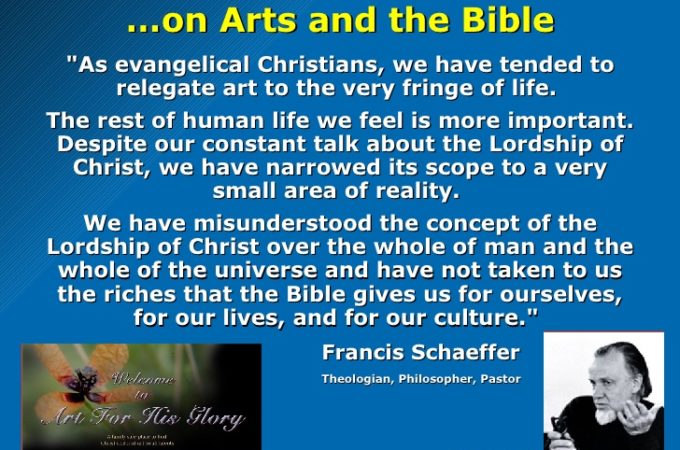
What most impressed me in knowing Edith at L’Abri was her emphasis on everyday beauty.

Arriving as a critical agnostic, I was surprised to meet Christians who actually cared about the world of ideas and the arts. It was not merely that Francis Schaeffer lectured about the arts, however.

It was also that Edith thought it important for the Christian to incorporate beauty into all of life — such as simple but elegant table settings with a flower and a candle. Not expensive items, not conspicuous consumption. But creative (expressing your unique personality) and natural (using items and themes from nature when possible).

Though I had grown up in the church, I had never before met Christians who understood that our souls hunger for beauty just as much as for truth and goodness.

For me, as for many others who studied at L’Abri in the days when Edith still presided, there was an apologetics of beauty that made me want Christianity to be true, at the same time that I was working through a philosophical apologetics that was persuading me intellectually that it was true.

Edith described her love of everyday beauty in Hidden Art (the title was later expanded to The Hidden Art of Homemaking).

Chalet-Les-Melezes-600x399Thanks, Nancy, for such a well-written tribute which has my wholehearted approbation.

For my own experience, I will never forget the first time I had dinner with the Schaeffers in their home, the Chalet Les Melezes. The table was beautifully set with candles, cut dried flowers and linen napkins. The meal was beautifully presented, fresh and delicious. Nothing fast about this meal: it was “slow food” before anyone knew the term.

Edith wrote:

Edith Schaefer

There is no occasion when meals should become totally unimportant. Meals can be very small indeed, very inexpensive, short times taken in the midst of a big push of work, but they should always be more than just food. Relaxation, communication, and a measure of beauty and pleasure should be part of even the shortest of meal breaks.

We learned the Apologetic of Beauty from Edith Schaeffer. Thank you Edith, for your life and all that you taught us through your life of hidden art!

- Darrow Miller

+3
0
  
Posted in Arts, Cultural Mandate, Culture | Tagged , , , | 4 Comments

Create Something on Earth to Hang on Heaven’s Wall

When I was in school, my teachers in two subjects taught me the concept of transposition. In math we learned to move a number and its sign from one side of the equation to another. In music we learned to move the pitch of a composition upwards or downwards.

But just recently I have been reintroduced to the word in the writings of William Dembski and the venerable C.S. Lewis. These writers have taught me that transposition is no less than a pathway between space and time creation, on the one hand, and the transcendent, eternal kingdom of God, on the other.

Human beings inhabit the boundary between the spiritual and the physical. Transposition is the pathway between these two realms. It is the movement between time and eternity, between the natural and the transcendent.

In this sense, transposition is a change in form or nature. In his book The End of Christianity mathematician and theologian William Dembski illustrates the concept of transposition with Beethoven’s Fifth Symphony.

We are all familiar with the transposition of information. Consider Beethoven’s Fifth Beethoven wrote music on earth that reflects the glory of heavenSymphony. It is a marvelously rich orchestral work. And yet a three-year-old can play the main theme from the first movement with one finger on a piano. Here the transposition is from a richer to poorer medium. Indeed, much is lost in transposing a full orchestral work to a piano version. But transposition need not be in the direction of impoverishment. It can also be in the direction of enrichment.

Dembski notes that the transposition can move either downward or upward. A complex orchestral piece can be transposed down to the piano or the simpler piano piece may be transposed up to a full orchestra. Listen to an orchestral version here, and compare the remarkable performance of a five-year-old autistic child here.

In his masterful essay Transposition (in The Weight of Glory), C.S. Lewis tells a fable. A woman in a dungeon uses pencil and paper in an attempt to depict the outside world to her son, who has never seen beyond their four walls. In her drawing, she sees the beauty of waving trees and dancing light. Not only does he not see these realities, but when he finds out that the real world has no actual pencil lines, his mental image goes blank. Her pencil can never capture “the coloured three-dimensional realities which are not enclosed in lines but define their own shapes at every moment with a delicacy and multiplicity which no drawing could ever achieve. The child will get the idea that the real world is somehow less visible than his mother’s pictures. In reality it lacks lines because it is incomparably more visible.”

From Heaven to Earth

The same higher-to-lower transposition is at work in the Lord’s Prayer (Mat. 6:10): your kingdom come, your will be done, on earth as it is in heaven, and in the Great Commission (Mat. 28:18-20): Go and make disciples of all nations…. teaching them to obey all I have commanded them.

What makes heaven heaven? Heaven is heaven because God’s will is done perfectly. Earth is not heaven, because God’s will is not done perfectly here.

Jesus wants the perfect kingdom of heaven to be expanded on earth as it is in heaven and therefore he commands his followers to disciple all nations. Through obedience to God’s ordinances the first fruits of heaven are manifested in our broken nations. Something from heaven is to be transposed to earth. This is the task given to God’s people.

After his resurrection and before his ascension Jesus is inaugurated King of heaven and earth. In Mat. 28:18-20, Jesus speaks first of his authority “all authority in heaven and earth has been given to me.” On the basis of that authority (“in heaven and on earth”) he commissions his followers: “Therefore GO! And make disciples of all nations … teaching them to obey all that I have commanded.” Note that because all authority has been given to Christ, all nations are to be discipled by teaching them to obey (read: internal self-government) all that Christ has commanded. The order of heaven is to be transposed to earth.

That which is higher, the transcendent, reveals the nature and potential of the lower, the “natural”. The Kingdom of God reveals what transformed community or nation might become and the purpose towards which we are to work. Your earthly purpose is revealed against the backdrop of the transcendent nature of the kingdom of God. Oh what wonder! Oh what beauty!

We see an example of this in that dimension of humanity which the world has so debased, our sexuality. The transcendent feminine reveals the profound nature of female biology to show compassion, nurture, and teach. Likewise, the transcendent masculine reveals the profound meaning of the male body to provide, protect, and lead. The communion of the Trinity, expressed in the Hebrew word yada - face-to-face intimacy, is the voice that draws “mere sex” into a mystical union. See here the Song of Solomon.

We are to live today, in the reality of the future coming of the kingdom of God.

From Earth to Heaven

Transposition between the eternal and the temporal is a two-way street. The lower may be transposed to the higher. Here we see the relationship between the Cultural mandate and the Great Commission

In Genesis 1, the Cultural Mandate to develop the earth is given by God to the first members of the human family (Gen. 1:26-18). This is the prologue of the transposition from the earth to heaven; the epilogue is the kings presenting the glory of their nations (Rev. 21:24). We are to create culture using the gifts and resources God endowed at creation. These resources are not merely to be used or crassly consumed; they are given as the raw material of human invention, discovery, and creativity. The human story, between the prologue and epilogue, is to be the creation of God-honoring culture. These artifacts, scientific discoveries, works of art, etc.—each a reflection of the glorious transcendence of God—are transposed, at the end of time, to adorn the new heaven and new earth.

For more on this see Scott Allen’s paper, The Cultural Dimension of the Great Commission and our blog series Great Commission Utilitarianism.

The Bible includes many images to help us understand the transposition from earth to heaven. Here are just three:

  • The new heaven and a new earth (Isa. 65:17; Rom. 8:21; Rev. 21:1).
  • A refiner’s fire to redeem, not destroy, the world (Pro. 25:4; Mal. 3:2; 1 Cor. 3:13; Rev. 21:5).
  • The resurrected Christ (John 20:26-29).

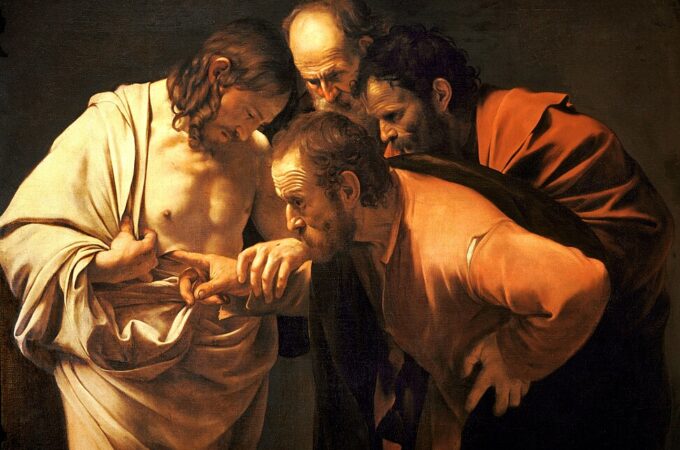
That last one begs elaboration. Note that Jesus passed through a wall to appear to the disciples. Then he then told Thomas to feel his hands and side. The scars were inflicted on earth, but Christ had a new body, without the limitations of his earthy body. Just as he had been transposed “down” in the incarnation, he is transposed “up” in the resurrection and accession.

In the book of Isaiah we witness the kingdom which is to come (Isa 25:6-8 NIV):

On this mountain the LORD Almighty will prepare
 a feast of rich food for all peoples,
a banquet of aged wine
the best of meats and the finest of wines.
On this mountain he will destroy
the shroud that enfolds all peoples,
the sheet that covers all nations;
he will swallow up death forever.
The Sovereign LORD will wipe away the tears
 from all faces;
he will remove the disgrace of his people
from all the earth.
The LORD has spoken.
 

At the end of history, the ravages of the fall – death, sorrow, tears—will be wiped away. What will we find in its place? Life in abundance, pictured as rich food, aged wines.

In Rev. 21:23-36 we read of the kings of the earth leading the parade of nations into the city. They will bring the glory and the honor of their nations. Are these the God-honoring artifacts of the cultural commission transposed from earth to be enjoyed in heaven? Perhaps we will enjoy the finest wines from Chile and the finest coffee from Ethiopia. We may eat the finest English pastries created by my grandfather at Bailey’s Bakery. Perhaps while we are enjoying the feast, an ensemble will play a Bach concerto.

Consider well how you spend your time, how you invest your life. The things you do on earth, for good or ill, count for eternity. What you create in this life that honors God may be transposed, at the end of time, to an adornment in His eternal kingdom.

-          Darrow Miller

0
0
  
Posted in Arts, Cultural Mandate, Culture, Discipleship, Great Commission, Kingdom, Music | Tagged , , , | Leave a comment

The POWER OF TRUTH in a World of Illusion

Christ followers have a story to tell, a story the world needs to hear. It is a powerful story that can transform individual lives, lift communities from poverty, and build nations that are free, just, and compassionate. It is God’s story.

Our story is not make-believe. Rather, it is the objective truth. It comports with reality.

Tolkien's Lord of the Rings depicted a fantasy world to reveal truthIn his trilogy, The Lord of the Rings, the great story-teller, J.R.R.Tolkein, created the realm of Middle Earth, home to dwarves, elves, humans, orcs, and, yes, hobbits.  Readers around the world have thrilled to follow the narrative. Why? Because Tolkien artfully reveals truth through fantasy. All good art, including fantasy, reveals Truth, Beauty, and Goodness. The rest creates illusions, counterfeit visions of lies (instead of truth), ugliness (instead of beauty), and evil (instead of goodness). Such “art” begets destructive worlds and lifestyles that impoverish human beings.

The Psalmist David reflected on the human phenomena of worshiping false gods, which is to live in a world of illusion: How long, O men, will you turn my glory into shame? How long will you love delusions and seek false gods? Selah (Psalm 4:2 NIV).

David recognizes that when a person rejects the worship of the glorious God, they do not worship nothing–they worship anything. That includes gods of their own making. Humans somehow are drawn to delusions, things that have no existence in reality. Deluded people begin their journey into lies by worshiping false gods, especially the gods of humanity (Pagan Humanism) and Nature (Pagan Animism).

But the worship of false gods has consequences. The human imagination creates a world of illusion, a “world” with little or no actual existence in reality. In such a world, the universe is upside down: evil is good, lies are true, the hideous is deemed beautiful. Consider, for example, pop culture. In its music, film, television, and video games, violence is glorified, while sex and material consumption are the ends of life. People are dehumanized, even replaced by machines. Family is passé, women commoditized, babies routinely murdered.

British lawyer and author, Philip Quenby, writing in Redeeming a Nation, speaks of the dangers facing his beloved England by the lies produced in the worship of false gods:

There is a great lie stalking our land. It says that one set of ideas is just as valid as another. It whispers that there is no objective truth and that morality is in effect merely a matter of opinion. If that were really true, there would be no basis on which to condemn murder, rape, child abuse or any other crime. Such foolishness has already cast a shadow over England. If we persist in acting as though it were true, we will once again find ourselves walking in darkness. Here is our challenge, for we risk slipping back towards paganism and idolatry.

When I was young in faith, I was discipled in Young Life. The Bible version of choice was J. B. Phillips’s paraphrase of the N.T.  I was challenged by reading 1 John 1: 5-10:

Here, then, is the message which we heard from him, and now proclaim to you: GOD IS LIGHT and no shadow of darkness can exist in him. Consequently, if we were to say that we enjoyed fellowship with him and still went on living in darkness, we should be both telling and living a lie. But if we really are living in the same light in which he eternally exists, then we have true fellowship with each other, and the blood which his Son shed for us keeps us clean from all sin. If we refuse to admit that we are sinners, then we live in a world of illusion and truth becomes a stranger to us. But if we freely admit that we have sinned, we find God utterly reliable and straightforward—he forgives our sins and makes us thoroughly clean from all that is evil. For if we take up the attitude “we have not sinned”, we flatly deny God’s diagnosis of our condition and cut ourselves off from what he has to say to us.

Note the similar concepts to David’s in the Psalms. When we live in darkness rather than light, truth becomes a stranger and lies become friends. In short, left to ourselves, we live in a world of illusion rather than in reality.

The life mission of British philosopher and novelist, Iris Murdoch (1919-1999),  was to call people from illusion to reality. She once said: “We live in a fantasy world, a world of illusion. The great task in life is to find reality.”

Three millennia earlier, the Wisdom of Solomon declared: “Foolish dreamers live in a world of illusion; wise realists plant their feet on the ground” (Proverbs 14:18, The Message). This warning is not tantamount to a call to stop dreaming. Rather, it is a call to shun foolish dreaming. We are to be wise dreamers whose dreams reflect the boundless glory of God himself. We are to dream to the limits of reality.

We live in a world where illusions are sacred and truth, goodness and beauty are profane. We need to push back against the lies and live in the reality of the glory of God and his creation 0rder!

- Darrow Miller

+2
0
  
Posted in Culture, Morality | Tagged , , , | Leave a comment

Darrow Miller, William Wilberforce and You

William Wilberforce was the brave Brit who spent a career in parliament fighting, and finally ending, the British slave trade. Darrow has often referenced Wilberforce as an example of a life spent bringing truth, beauty, and goodness to the world.

Another Wilberforce champion is our friend and co-laborer, John Stonestreet of Summit Ministries and BreakPoint. As Darrow puts it, It’s always a delight to meet people whose heart beats as your own. John is one of those guys. He is very “DNAish.”

John and his colleagues produce videos call Re-Engage. Here’s a recent edition — Redemption Everywhere: Faith that Walks – that will challenge you to think, and live, like Wilberforce.

Spend six minutes to enjoy, learn, and be challenged. … Then see the important note below.


Note: As the video indicated, Darrow will be on the platform at the 2013 Wilberforce Weekend in Arlington, VA. This is a great opportunity to “join the Colson Center and activists, innovators and catalysts who are leading the ‘little platoons’ evidencing the love and justice of the Kingdom of God in the midst of the kingdoms of this world and in their communities. Get inspired to seek the welfare of the city in which you live.”

Go here to learn more and register.

Maybe you have more in common with Wilberforce than you realize.

0
0
  
Posted in Culture, Kingdom, Wholism | Tagged , , , | Leave a comment

ABRAHAM LINCOLN: A Bigot by Today’s Standard?

Lincoln would be politically incorrect todayWhat does Abraham Lincoln have to teach us about tolerance?

Some years ago I heard a Christian leader relate a conversation he’d had with his son upon his graduation from public high school. “What values were you taught?” he asked the young man. “No values,” was the grad’s initial reply. But after another moment of thought, he corrected himself: “Actually, there was one value. Tolerance.”

Webster’s 1828 (the dictionary of choice at the DNA) defines tolerance as “The power or capacity of enduring; or the act of enduring.” In other words, in a Judeo-Christian  context, tolerance is respecting people even if we disagree with their ideas. In this framework, moral and metaphysical truth exists.

A more modern lexicographer, dictionary.com, includes the above definition. But only in fourth place. Top-of-the-list status goes to “a fair, objective, and permissive attitude toward those whose opinions, practices, race, religion, nationality, etc., differ from one’s own; freedom from bigotry.” This concept of tolerance, grounded in atheistic materialism without absolutes, means we accept all ideas as equally valid. We even tolerate lies and evil.

In other words … and this will sound familiar … here in the West, only one position is forbidden. You must never declare, on moral grounds, “Thou Shalt Not.”

recent post by blogger Michael Metzger dismantles this point of view. His argument is all the more intriguing in that he begins from the recent, award-winning film by Steven Spielberg, Lincoln. Metzger points out that Lincoln’s ability to frame “thou shalt not” statements was exactly what made him such a persuasive leader. He spoke with moral convictions, but without a legalistic or negative  attitude. We would do well to emulate his example. He spoke the truth in love. He challenged the politically correct with moral conviction, yet in a way that honored his opponent as a fellow human being.

Lincoln tapped into the power of negation in language. He wasn’t reticent to utter prohibitions such as Thou Shalt Not. Wilson writes that, “as with Shakespeare and Emily Dickinson, both of whom had a comparable gift, this may be an aspect of Lincoln’s literary genius.”1 Almost all of Lincoln’s rhetorical efforts used negative constructions, or prohibitions, to give his ideas gravitas. One of his most ardent lines – “Fellow-citizens, we cannot escape history” – stuck a cultural nerve, as did his famous notation, “If slavery is not wrong, nothing is wrong.”

In the “tolerance” milieu of the West, what an irony that we honor a president whose greatness, in large measure, lay in his inclination to label certain behaviors wrong. Abraham Lincoln was unfettered by the current definition of tolerance: ” … freedom from bigotry.”

Conceivably, by such a standard, the Great Liberator would be considered a bigot today.

Read Metzger’s fine post here.

- Gary Brumbelow

+3
0
  
Posted in Culture, Ethics, History, Language, Morality | Tagged , , , | Leave a comment

HOW DO WE MEASURE the Great Commission?

We don’t all measure the Great Commission the same way … and the differences aren’t trivial.

I’m a big fan of John Piper and have been helped tremendously by his teaching. However, he recently wrote a paper, How Much is Left to Do in Great Commission, which reflects a very narrow understanding of Christ’s task for the church. He basically proposes that the Great Commission will be completed once churches are planted in the remaining unreached people groups.

Granted, this is probably the dominant understanding of the Great Commission in evangelical circles. But it doesn’t comport with what Jesus actually told us to do. He said “make disciples of all nations” and “teach them to obey all I have commanded.” These are different than making converts and planting churches. I would submit that evangelism and church planting are essential parts of accomplishing this larger task, but not the whole.

Dr. Piper defines missions as “crossing a culture, learning a language, and planting the church through preaching the gospel among people groups that have no churches strong
enough to evangelize their group.“ In this context, an “unreached” people is one “fewer than 2% evangelical.” Once again, these concepts have wide agreement in the evangelical missionary community. Yet by this definition, many nations have been reached–they have churches and are over 2% evangelical–yet are rife with poverty, corruption, and injustice.

Probably two-thirds of Rwanda’s citizens were in church on any given Sunday in 1994, including the Sunday in April before the genocide erupted in which over a half million people perished. Is Rwanda before the genocide a model of the Great Commission accomplished? Another example is Guatemala, one of the poorest, most corrupt … and most evangelized nations in the Western Hemisphere.

We cannot fulfill the Great Commission without making disciples, training believers to be like Christ. And because Christ is Lord over all creation, the task also includes bringing God’s truth into every sphere of society and every arena of public life. These goals are somehow missing in the prevailing definition of the Great Commission. The line needs to be pushed out much farther. I would set as the end goal of the Great Commission the visions given in prophesies like Habakkuk 2:14, For the earth will be filled with the knowledge of the glory of the LORD as the waters cover the sea.

Here’s another picture of the fulfilled Great Commission:

Psalm 67. To the choirmaster: with stringed instruments. A Psalm. A Song.

1 May God be gracious to us and bless us and make his face to shine upon us, Selah
2 that your way may be known on earth, your saving power among all nations.
3 Let the peoples praise you, O God; let all the peoples praise you!
4 Let the nations be glad and sing for joy, for you judge the peoples with equity and guide the nations upon earth. Selah
5 Let the peoples praise you, O God; let all the peoples praise you!
6 The earth has yielded its increase; God, our God, shall bless us.
7 God shall bless us; let all the ends of the earth fear him!
 

The narrow view of the Great Commission has another weakness: it limits the task to a tiny minority of the church, i.e. those who are called to cross-cultural, pioneer church planting. Are we to assume that Christ gave the Great Commission only to these people, as important as their task is? What about the rest of the church? In the broader view of the Great Commission, we all play a part. We are all called to the mission Christ gave.

- Scott Allen


0
0
  
Posted in Church, Discipleship, Evangelism, Great Commission, Mission | Tagged , , , | 5 Comments

THE BIBLE Has Something to Say About Work?

What army would leave the vast majority of its soldiers in the barracks while going into battle? In one sense, that’s exactly what the church has done. We have gone to war with only a fraction of our soldiers mobilized. We’ve relegated the work of discipling the nations to pastors, missionaries, and other “career” Christians.

The result? A tiny slice of kingdom workers to do the work of all. Consider these statistics.[1]

Tiny fraction of Christian to do the work of the kingdom

Global Christians in two groups: Workers (pastors/missionaries, etc), and Unmobilized (all others)

  • About 2.18 billion Christians in the world
  • Total Christian workers (pastors and missionaries) are estimated to be 5.9 million

The resulting ratio is pictured in the pie chart. A better illustration of “a picture tells a thousand words” would be hard to find.

All that to introduce you to something we recently became aware of: the Theology of Work Project.

What if you really believed in changing the world? Where would you start? That question prods people of conscience in any culture; and Christians are no exception. Now, perhaps for the first time in human history, technology, worker interest and scholarly expertise have merged to make possible the exploration and recording of a comprehensive body—a theology—of Scripture’s timeless truths and the timely application of those truths into working cultures everywhere. Following the path first laid out by the field of missions and missionary endeavors in the Lausanne Covenant, we begin this journey with an earnest desire to expand our knowledge of how God would have us do our daily tasks. We invite you to join us on this trek.

If the “army” metaphor isn’t obvious there, consider this: the ultimate goal of the Theology of Work Project is “to help workers perceive God’s purpose, meaning, and value in their work, and to bring Christ’s redeeming power into the fabric of their workplaces.”

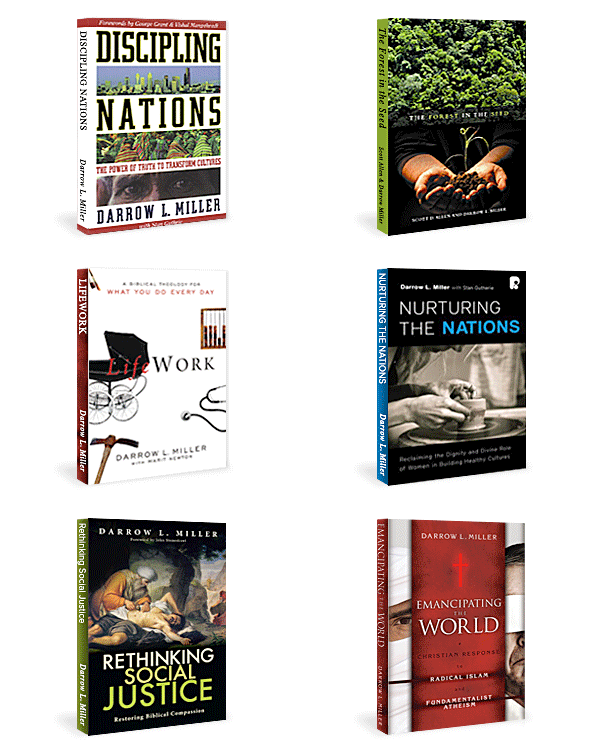
Our readers who are familiar with Darrow Miller’s work will immediately recognize the synch between the Theology of Work Project and Darrow’s book, LifeWork: A Biblical Theology for What You Do Every Day

The project has brought together scholars and workplace practitioners  to “build consensus around fundamental truths contained in a Theology of Work consistent with orthodox historical Christianity.” The group plans to examine every book of the Bible for its content about work. They have published papers  (available online here) on well over half the Bible’s books already.

Kudos to this effort. May their impact for the kingdom be deep and wide.

- Gary Brumbelow


[1] From Answers.com. The accuracy of the actual numbers may be open to question, but the gist of what they convey is probably undisputed.

+3
0
  
Posted in Kingdom, Theology, Vocation | Tagged , , , | 4 Comments