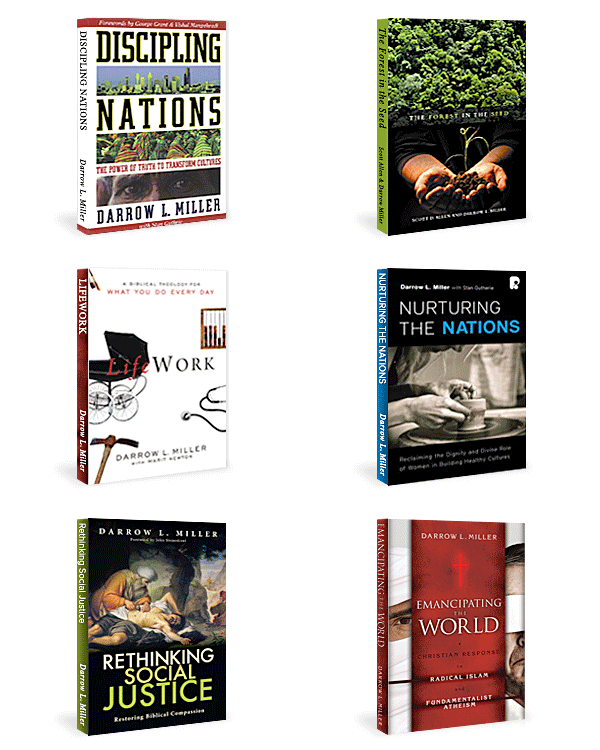
The phrase “social justice” has made a surprising comeback within Evangelical circles in the past few years. But what exactly do people mean when they use this phrase? For some, it simply means helping the poor in general, but I’ve found that when you push a bit, it often involves a particular approach,
Category: Poverty
Total 109 Posts
Almost a quarter century ago a group of scholars, relief and development practitioners, and missionaries gathered near L’Abri Fellowship in Villars, Switzerland, to discuss, debate, and reflect on the state of global hunger and poverty and the Christian response to the chronic and tragic situation. The result of their work
Chris Wassell recently sent me the brief video below. I thought well worth passing on to our readers. The video shows the contrast between countries with the greatest economic freedom and those with the least. It shows very clearly how true is the expression, “Ideas have consequences!” If we want to
The Wall Street Journal recently published an article by Allan Meltzer (A Welfare State or a Start-up Nation) which raises an issue deeper than tax-code revision and other mechanical differences between welfare states and start-up nations. Mr. Meltzer is speaking to a worldview issue centered [in or on] the concepts of riches vs. wealth.
About ten years ago I began to feel restless about the work of the missionary organization I was part of. To be sure, there was lots to be happy about. We had dedicated missionaries very effective at building relationships in the community and sharing the gospel. People were coming to
Perhaps few people are aware of the powerful impact the Protest Reformation had on life expectancy in Europe. Prior to the 16th century European Reformation, virtually the entire world was poor including all of Europe. Andrew Bernstein, adjunct professor of philosophy at Pace University, writes: Most people forget that pre-industrial
Marvin Olasky, editor of WORLD, recently pointed out that yes, increased charitable giving is essential to attacking poverty, but without the transformation of cultures, money is not enough. In his column, The Promise and the Overpromise, Mr. Olasky referenced one of Darrow’s books: … why do some Christians emphasize the
My good friend Bryan Barrett recently put me on to a story I had never read: the Tower of the Black Cloister. In this tower, the history of the world turned a profound corner. Most people view the Reformation as a theological phenomenon, and certainly it was that. But the
[Vishal Mangalwadi argues that we have much to learn from a couple of Scots who wanted to care for widows and did something about it. Go here to read his original, unedited post of which the following is a condensation.] Almost 300 years ago, two Calvinist pastors in Scotland combined a pro-life, pro-sex, pro-marriage
[The following post, refreshed from its original publication, is highly relevant to the current political-economic environment.] The global economic crisis is, at its root, a moral and metaphysical crisis. Our economic principles and polices are founded on assumptions which are either theistic or atheistic. One set of assumptions fits reality the