In 1889, Jane Addams founded Hull House, a Chicago charity that prided itself in the absence of religious affiliation. This product of Social Universalism became the inspiration of governmental social work programs of the 1930s and community action programs of the 1960s. The nation’s first major political attempt at a

Tag: Poverty
Horace Greeley was America’s leading journalist of the 19th century. A Universalist, Greeley believed that people were naturally good and that every person has a right to both eternal salvation and temporal prosperity. While Greeley considered himself a Christian, he rejected the biblical idea that a man’s sinful nature leads
It has been said that cultures build systems of charity in the image of the God they worship. In other words, the foundational belief systems of a society will inevitably determine the culture of that society, which, in turn, will shape its institutions and programs—including those dedicated to poverty fighting.
Sergiu Klainerman was born to a Jewish family in Bucharest in 1950, in the impoverished Communist “prison state” that was Nicolae Ceaușescu’s Romania. After high school he studied Mathematics at the University of Bucharest. His circumstances and culture afforded little opportunity: he could hope for little more than being a
Three questions interweave in ways that may not be immediately evident: they all relate to the moral universe. Why are the Jews God’s chosen people? Why are some nations rich and others poor? Why have Jews been so persecuted throughout history? I have pondered these questions much of my adult
Genesis chapter 3 records the rebellion and consequent fall of humans. The creation fell under a curse, and a vicious cycle of human poverty began. People worshiped gods of their own imagination, small family gods, tribal gods, capricious gods of nature with limited power. These gods were unpredictable, they ruled
Evolutionists explain poverty in material terms Given that more Christians are alive than at any time in world history, that more churches (and more large churches) exist, why do our nations remain so broken? Secularism says that the roots of human brokenness in its many manifestations (hunger, poverty, injustice, environmental
Jesus said, “The poor you will always have with you” (Matt. 26:11). Two millennia later, 815 million people lack enough food to lead a healthy, active life.[i] Nine million people die every year of hunger or hunger-related causes.[ii] These numbers are down from forty years ago—that’s good. But this level of
Indian scholar and DNA friend Vishal Mangalwadi was recently interviewed by a German-language publication about Western assistance to Africa. We are happy to point our readers to this remarkable Q&A. ~ A great deal of development aid has already been provided in Africa. Why does nothing seem to change? Finland
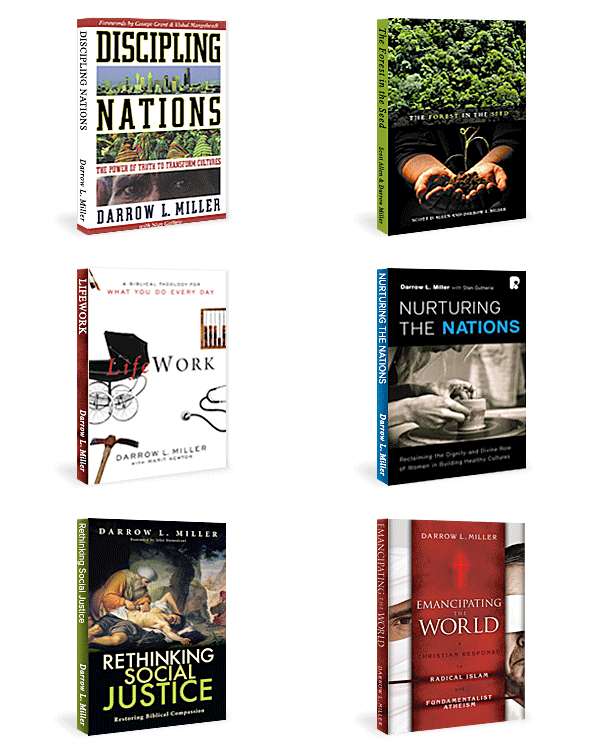
Recently, a Christian brother published a “sympathetic critique” of Darrow’s book Discipling Nations. He raised issues about Disciple Nations Alliance teaching that have been noted by others from time to time. Because of that, and in the spirit of a free exchange of ideas, we offer here, in six parts, our brother’s critique and