My recent post Why So Much Heat About Social Justice? Part 2 generated such a thoughtful comment from a reader that I want to use a new post to respond. Thanks, Steve, for taking the time to write. Your remarks suggest that we have a mutual desire to live from the framework of orthodox Christianity.
Tag: Poverty
Total 77 Posts
A vigorous conversation is happening today around the question, “What is the mission of the church?” A few weeks ago, Tim Keller addressed the topic in this blog post on the Redeemer City to City website. In the article Keller puts the conversation under the banner of two related topics:
The phrase “social justice” has made a surprising comeback within Evangelical circles in the past few years. But what exactly do people mean when they use this phrase? For some, it simply means helping the poor in general, but I’ve found that when you push a bit, it often involves a particular approach,
Darrow Miller, in an article entitled Agriculture and the Kingdom of God, includes this compelling example of what can happen when missionaries lose sight of the extent of God’s Big Agenda: About twenty years ago, evangelical missionaries moved into the unreached agricultural communities of the poorest province of Guatemala. They
Chris Wassell recently sent me the brief video below. I thought well worth passing on to our readers. The video shows the contrast between countries with the greatest economic freedom and those with the least. It shows very clearly how true is the expression, “Ideas have consequences!” If we want to
The Wall Street Journal recently published an article by Allan Meltzer (A Welfare State or a Start-up Nation) which raises an issue deeper than tax-code revision and other mechanical differences between welfare states and start-up nations. Mr. Meltzer is speaking to a worldview issue centered [in or on] the concepts of riches vs. wealth.
Perhaps few people are aware of the powerful impact the Protest Reformation had on life expectancy in Europe. Prior to the 16th century European Reformation, virtually the entire world was poor including all of Europe. Andrew Bernstein, adjunct professor of philosophy at Pace University, writes: Most people forget that pre-industrial
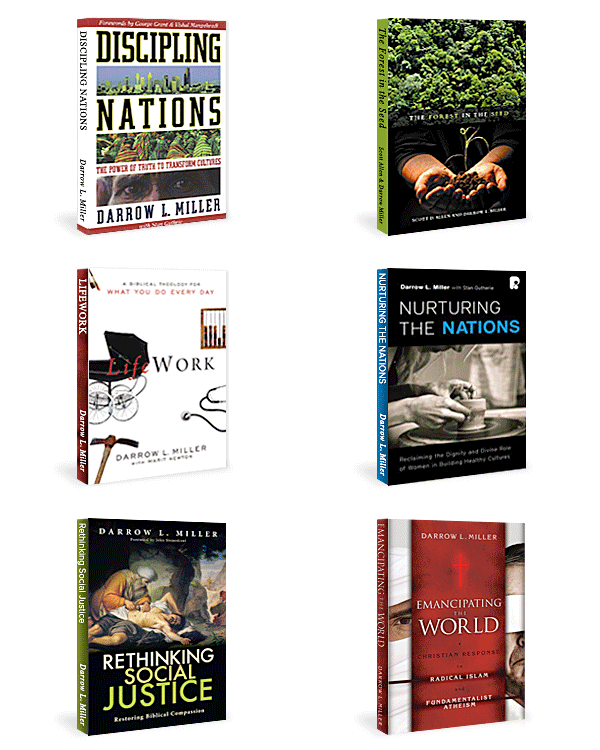
Marvin Olasky, editor of WORLD, recently pointed out that yes, increased charitable giving is essential to attacking poverty, but without the transformation of cultures, money is not enough. In his column, The Promise and the Overpromise, Mr. Olasky referenced one of Darrow’s books: … why do some Christians emphasize the
The Bible begins in a garden and ends in a city. That’s a positive progression from God’s perspective. He intends human beings to develop the natural resources He put in the creation. When we do, hungry people are fed, the sick receive care, the naked are clothed, children grow, families
The following account is taken from an article by DNA associate Vishal Mangalwadi. Thirty years ago, Yong Am was one of South Korea’s poorest villages. It offered no school for the children and no jobs for the adults. Today, a typical small farmer earns over $60,000 per year and the