
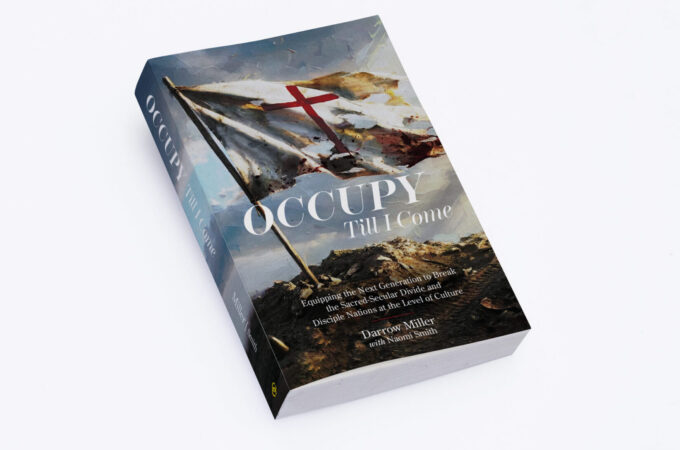
This may be the single most important blog in this series for American readers in 2026.
As America celebrates its 250th anniversary, we need to ask a question that reaches far deeper than politics:
What kind of people built America—and what kind of worldview shaped them?
To answer that question, we need to go back to a Bible.
The Geneva Bible was the Bible of the English Reformation, the Pilgrims, the Puritans, and generations of English-speaking Christians who crossed the Atlantic and helped shape the foundations of American life.
But the Geneva Bible was unique. It did not simply provide a new English translation of Scripture. It helped ordinary people learn to think biblically about the whole of life.
Its extensive marginal notes brought biblical interpretation into the hands of everyday Christians. Its readers were taught to consider questions of authority, government, justice, liberty, covenant, conscience, and the responsibilities of both rulers and citizens.
In essence, the truths of the Bible were brought to bare on the pertenant issues of their day and ordinary people were empowered to stand in these truths with conviction.
The Bible was no longer confined to the pulpit or the monastery. Families could read it together. Communities could discuss it. Individuals could wrestle with its claims. And people began to see that the Word of God spoke not only to their private spiritual lives but also to the way they ordered their families, churches, communities, and governments.
This was one of the great contributions of the Reformation: the recovery of a biblical worldview that refused to divide life into sacred and secular compartments.
The Geneva Bible became part of the theological and intellectual heritage carried into the New World by the Pilgrims and Puritans. Its influence was part of a much larger Protestant tradition that emphasized the authority of Scripture, the accountability of rulers, the dignity of conscience, and the idea that political power is not absolute because every earthly authority stands beneath the authority of God.
That heritage would eventually become part of the intellectual soil from which the American founding emerged.
This does not mean the founders were all identical in their theology, nor that America’s founding can be reduced to one Bible or one tradition. The story is more complex than that.
However, it’s essential to understand that the people who built this nation did not emerge from a secular vacuum nor did they derive their insights from pagan worldviews.
They inherited a worldview deeply influenced by centuries of Christian thought and by generations of people who had learned to read Scripture as a book that spoke to every sphere of life.
Why This Matters for America’s 250th Anniversary
As America celebrates 250 years since 1776, countless voices are attempting to rewrite the founding story—to erase or minimize the Christian contribution to the formation of the American experiment.
This is simply bad history.
The biblical worldview that shaped generations of Americans influenced the language and concepts surrounding liberty, human dignity, conscience, moral responsibility, and the limits of political power.
The conviction that human beings possess rights that do not originate with the state. The belief that rulers are accountable to a higher authority. The suspicion of concentrated power. The protection of conscience. The conviction that liberty requires virtue and that a free people must govern themselves.
These ideas did not emerge from thin air.
Nor did they emerge from pagan philosophy.
They developed within a civilization profoundly shaped by the Bible and by Christian reflection on the nature of God, humanity, government, justice, and freedom.
And this brings us to the “outlaws.”
The Geneva Bible was produced in the context of religious persecution and political conflict. At various points in English history, Protestant Bibles and unauthorized translations were suppressed, and those who printed, possessed, or distributed forbidden religious texts could face serious consequences.
Yet the Word of God continued to travel.
It crossed borders.
It crossed oceans.
It found its way into the hands of ordinary men and women who believed that their ultimate allegiance belonged not to the state, but to God.
These faithful “outlaws” became part of a movement that would profoundly influence the world.
They carried a Bible.
They carried a worldview.
And they carried a vision of human beings who were accountable to God and therefore not ultimately owned by kings, governments, or institutions.
The Sacred-Secular Divide Exposed
This is precisely where the story of the Geneva Bible intersects with the message of Occupy Till I Come.
For too long, the Church has accepted the narrative that faith belongs in the private sphere while public life belongs to the secular world.
But that was not the worldview of the Reformation.
And it was not the worldview of the Christians who helped shape the early American experience.
The Bible was not merely a book for Sunday.
It was a book for life.
It spoke to the family, the marketplace, education, government, justice, economics, community, and culture.
The Lordship of Christ was not limited to the sanctuary.
Christ is Lord of all.
This does not mean that the founders wanted a theocracy. It does mean that many understood something we desperately need to recover today: a free people cannot remain free without the moral and spiritual foundations necessary to sustain liberty.
Freedom requires virtue.
Virtue requires truth.
And truth ultimately requires a people who recognize that they are accountable to Someone greater than themselves.
The sacred-secular divide tells us that our faith belongs in one compartment of life and our public responsibilities belong in another.
The biblical worldview says otherwise.
There is no sphere over which Christ is not Lord.
Your Challenge This Week
Read Chapter 22 of Occupy Till I Come slowly.
Then ask yourself:
If the biblical worldview was part of the intellectual and spiritual inheritance that helped shape America, what does faithful “occupation” look like for me in 2026?
How can I help recover biblical foundations in my household?
In my church?
In my community?
In my vocation?
In my nation?
We are approaching America’s 250th anniversary at a critical moment. The question is not simply whether we will celebrate the past.
The question is whether we will understand it well enough to build the future.
This chapter alone may change the way you read American history—and the way you pray for her future.
We are almost through Part 2.
Next, we enter Part 3—the practical “how” of breaking the sacred-secular divide and occupying every sphere until He comes.
Get your copy of Occupy Till I Come and read Chapter 22 this week.
It is worth its weight in gold in this anniversary season.
Closing Prayer
Lord Jesus,
Thank You for the faithful men and women who carried Your Word across the sea and helped lay foundations that shaped a nation.
As we approach the 250th anniversary of American independence, awaken Your Church once again to the power of Your truth.
Give us courage to occupy every sphere You have entrusted to us—not in fear, but in the confidence that Your Kingdom has come and is coming.
May the next 250 years see a generation that loves Your Word, walks in Your ways, and disciples nations at the level of culture for Your glory.
In the mighty name of Jesus,
Amen.
For the Kingdom,
Darrow Miller and Friends
 Print this page


2 Comments
Elizabeth Youmans
July 23, 2026 - 12:00 pmThe Geneva Bible’s marginal notes concerning Christian self-government so frightened King James that he “authorized” his own translation in 1611 and stated there would be no marginal notes in his translation! The Geneva Bible was also the Bible of Shakespeare, commonly called the “Bard of the Bible.”
admin
July 28, 2026 - 10:37 amElizabeth,
Thank you so much for your added insight on the powerful impact of the Geneva Bible!